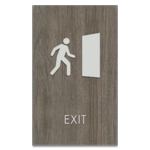
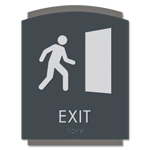
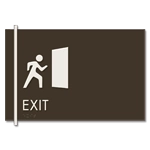
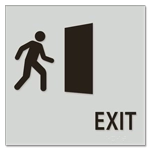
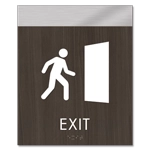
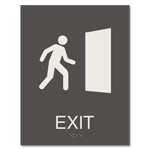
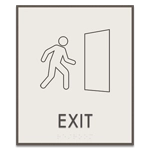
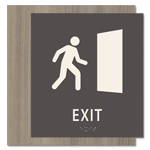
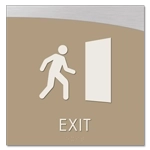
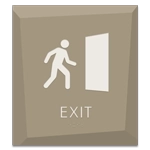
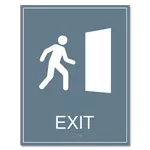
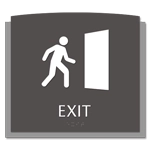
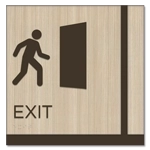
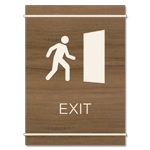
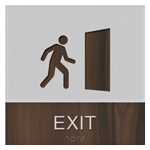
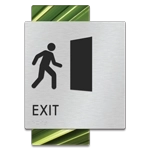
Choose a Style That Fits Your Sign System
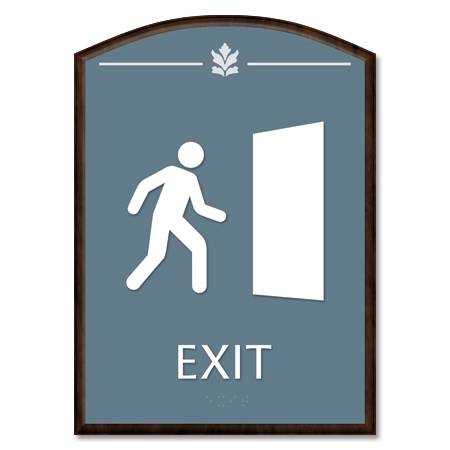
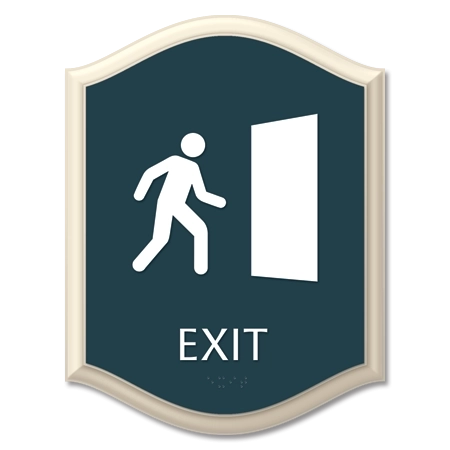
Exit identification is required for life safety, but the sign itself can still coordinate with the surrounding environment. Choose a design that complements nearby room identification, restroom, and directional signs while maintaining clear contrast and legibility.
When ordering, consider:
- Sign Style: Coordinate the shape, finish, and overall design with the facility’s interior sign system.
- Color Contrast: Choose a text-and-background combination that keeps the EXIT message and symbol easy to distinguish.
- Location: Match the sign to the specific exit condition rather than assuming the same identification belongs at every door.
- Project Consistency: For facilities with multiple applicable exits, use a coordinated design across locations to create a consistent visual system.
What the Exit Symbol Adds
These signs pair tactile EXIT identification with a raised symbol, giving occupants both text and graphic cues while allowing the sign to coordinate with a pictogram-based interior signage system.
The symbol is a supporting design element rather than a substitute for required tactile identification. Where tactile exit identification is required, the raised EXIT characters and braille remain critical components of the sign.
Check the Exit Location Before Ordering
Not every egress location requires the same type of sign. The 2010 ADA Standards for Accessible Design require tactile identification at doors serving exit passageways, exit discharge, and exit stairways. The 2024 International Building Code, Section 1013.4 also addresses raised character and braille EXIT identification at specified locations, including exit stairways or ramps, exit passageways, horizontal exits, exit discharge, areas of refuge with direct access to a stairway, and exterior areas for assisted rescue.
That makes the door’s role within the means of egress an important part of product selection. Confirm the required message and sign type for the specific location with the authority having jurisdiction before ordering.
Choose the Right Exit Sign for the Door
These signs pair tactile EXIT identification with a raised symbol for applicable exit locations. If the door or location communicates something different, choose the sign that matches that condition.
- Use Emergency Exit Only Signs for doors reserved for emergency use rather than normal circulation.
- Use Exit Route Signs where occupants need directional information along the path of travel.
- Use Not an Exit Signs where a door or passage could be mistaken for an exit but isn’t part of the designated egress route.
For a larger project, shop Exit Signage to coordinate the different messages needed along the means of egress.
|  Log In
 Contact Us




 View product photos



 = exterior & interior use
 = interior use only