ADA Braille Requirements for Healthcare Signage
Braille is a core part of accessible signage, but it is not required on
every sign. The ADA requires contracted, or Grade 2 braille where
tactile characters are required, with exact specifications for dot shape,
size, spacing, positioning, and installation. This chapter explains which
healthcare signs need braille and the rules those signs must meet.
Meeting ADA sign specs is all in the details. From dot shape and
capitalization to alignment, positioning, and spacing, braille must
follow specific requirements. While federal ADA standards do not
mandate left or centered alignment, California specifically requires
braille to be either left-aligned or centered, meaning right-alignment
is not compliant in California. We've broken the regulations down into
five core guidelines.
ADA Braille Sign Basics: What You Need to Know
Which Signs Require Braille?
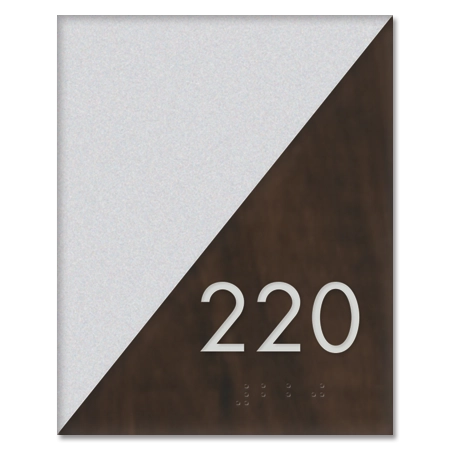
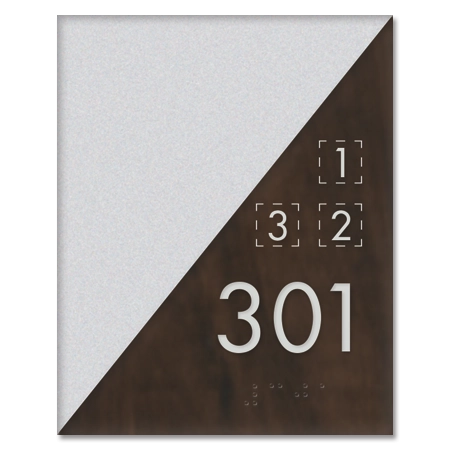
Braille is required where tactile characters are required. In healthcare settings, this includes signs identifying permanent rooms and spaces such as resident or patient room numbers, restrooms, or other spaces that are unlikely to change over time.
Tactile identification is also required at doors to exit stairways, exit passageways, and exit discharge.
Directional and informational signs follow the ADA visual character rules which do not require braille because they provide directions or information about the interior space or facility where they're installed.
For an assisted living facility, physician office, or vet clinic, the key question is what purpose the sign serves.
A permanent room or space designation requires tactile characters and braille; a sign that only provides directions or information generally does not.
Grade 2 Braille is the Standard
Where braille is required, the ADA requires contracted, or Grade 2 braille.
Grade 2 braille uses contractions for common words and letter combinations, allowing the same message to be communicated more efficiently in a smaller space.
It is the standard used for ADA tactile signage.
A Closer Look at Braille Guidelines
Meeting ADA sign specs is all in the details. We've broken the regulations down into five core pillars to help you
master the standards for your ADA signs:
Dot Shape
Braille dots must have a domed or rounded shape for easy tactile reading.
Capitalization
Under ADA §703.3.1, braille capitalization indicators are permitted only for the first word of
sentences, proper nouns and names, individual letters, initials, and acronyms. Standard room
identification labels, such as RESTROOM or EXAM ROOM, do not require capitalization indicators,
even when the raised lettering is uppercase.
Positioning
Braille must be positioned below the corresponding text. If the text has multiple lines, the braille
must be placed below the entire message.
Spacing
Braille must be separated by at least 3/8 inch from other tactile characters, raised borders, and
decorative elements.
ADA Braille Dot and Cell Dimensions
The ADA also sets exact dimensions for braille dots and cell spacing.
These measurements are not design preferences; compliant braille must stay
within the ranges established in §703.3.1 of the
2010 ADA Standards for Accessible Design.
| Measurement |
ADA Range |
| Dot base diameter |
0.059-0.063 in. (1.5-1.6 mm) |
| Distance between two dots in the same cell |
0.090-0.100 in. (2.3-2.5 mm) |
| Distance between corresponding dots in adjacent cells |
0.241-0.300 in. (6.1-7.6 mm) |
| Dot height |
0.025-0.037 in. (0.6-0.9 mm) |
| Distance between corresponding dots in cells directly above/below |
0.395-0.400 in. (10.0-10.2 mm) |
Why ADA Signs Matter
One of the most frequently asked questions about ADA braille signs is installation height. The ADA establishes a clear mounting range for tactile characters to provide consistent, accessible placement.
ADA braille signs must be installed so that the baseline of the lowest tactile character is no less than 48 inches above the finished floor, and the baseline of the highest tactile character is no more than 60 inches above the finished floor.
HealthcareSigns.com recommends a simple and effective method: centering the sign at 54 inches above the finished floor. Centering our standard tactile signs at 54 inches keeps the tactile characters within the required 48-inch to 60-inch range.
Location matters, too. Tactile signs must be installed in the required position beside the door, with clear floor space provided so a person can approach and read the sign without being obstructed by the door swing.
Your Trusted Partner for ADA-Compliant Braille Signs
HealthcareSigns.com designs and manufactures ADA braille signs to meet the applicable federal requirements for tactile characters and braille. Our ADA Compliance Guarantee backs the compliant signs we manufacture, so accessibility is built into the sign—not treated as an afterthought.
This chapter on braille requirements is one part of our comprehensive Definitive Guide to ADA Sign Requirements. Continue with our chapters on colors and color contrast, font requirements, sign height, and symbols and pictograms.
We're Here to Help
Ready to start your project or still have questions? Our team can help you select compliant signs, coordinate colors and materials, review your facility needs, or develop a complete sign schedule.
Share your floor plan for a free consultation, contact our signage experts, or use live chat in the lower right of your screen.
|
 Log In
 Contact Us




 View product photos



 = exterior & interior use
 = interior use only